Airway-Focused Dentistry in Scottsdale, AZ
How your jaws, tongue and teeth shape the way you breathe and sleep, for adults and children
 Clinically reviewed by Dr. Kamran Fattah, DMD
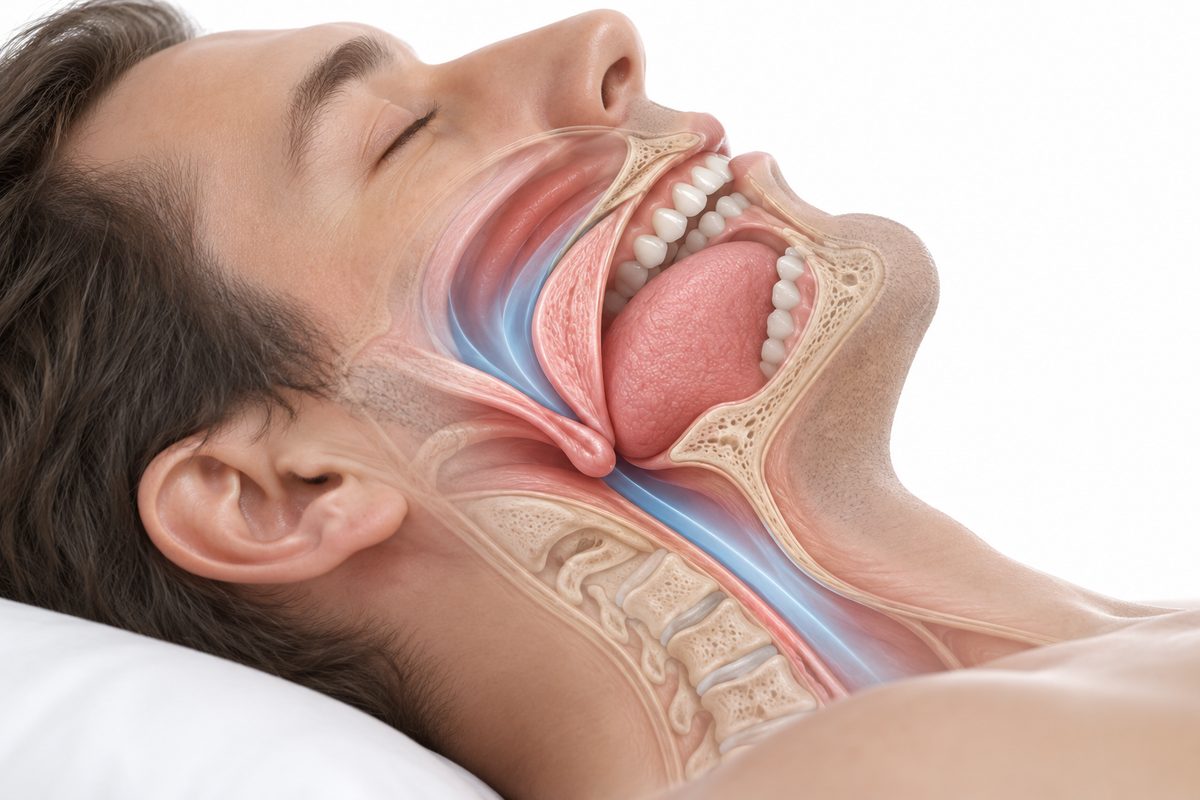
Maybe you wake up tired no matter how long you sleep. Maybe your partner has mentioned your snoring, or you have noticed your child breathing through their mouth at night. These concerns are common, and they are worth taking seriously. You don't have to work out on your own what they mean.
Airway-focused dentistry looks at how the structures of your mouth (the size of your jaws, the room for your tongue, how your tongue rests and moves, and your bite) affect breathing, sleep and oral function. We listen first, look carefully, and explain what we find. When a medical diagnosis is needed, we work with a board-certified sleep physician and your other healthcare providers.
Request an Airway Evaluation- What it is
- Mouth, breathing & sleep
- Signs to mention
- Screening vs. diagnosis
- Your evaluation
- Treatment paths
- Benefits & limitations
- FAQ
Key takeaways
- The shape of the jaws, the space for the tongue and how the tongue functions can all affect breathing during sleep.
- Dentists can screen for airway problems, but only a board-certified sleep physician can diagnose sleep apnea, using a sleep study.
- We evaluate adults and children from age 3, including tongue tie, jaw development and 3D airway imaging.
- Options include oral appliances, Vivos, laser therapy, tongue-tie release and gentle expansion, often alongside myofunctional therapy.
- Every plan is built with you, and results vary from person to person.
What Is Airway-Focused Dentistry?
Your airway runs from your nose and mouth down through your throat. Much of what surrounds it, including the upper jaw that forms the floor of the nose, the lower jaw that supports the tongue, and the tongue itself, is part of what dentists already examine every day.
Airway-focused dentistry uses that view to ask a broader question: is the way your mouth has developed, or the way it functions, making breathing harder, especially at night? For some people, the answer leads to a simple appliance or a referral. For others, it changes how we plan orthodontics, a night guard or other dental care.
It is not a separate specialty, and it does not replace medical care. It is a way of making sure breathing and sleep are part of the conversation at the dental office.
How Your Mouth Shapes Breathing and Sleep
These are the areas we pay attention to, and why they matter.
Jaw size and tongue space
When the upper or lower jaw is narrow or set back, the tongue has less room and can fall back toward the throat during sleep. Crowded teeth are one common clue to a jaw-size mismatch.
Tongue posture and tongue tie
At rest, the tongue normally sits against the palate. A tight frenulum (tongue tie) can keep it low, which can affect swallowing, speech, breathing and, in growing children, how the palate develops.
Nasal and mouth breathing
Breathing through the nose is the body's default. Habitual mouth breathing, especially in children, is a sign worth investigating, and it can be linked to nasal obstruction, enlarged tonsils or adenoids, or oral posture.
Grinding, jaw pain and sleep
Nighttime grinding can be linked to brief awakenings or disrupted breathing during sleep. That's why we check breathing before recommending a night guard; in some people, a guard can make sleep-disordered breathing worse.
Signs Worth Mentioning to Us
None of these means something is wrong on its own, but together they help us decide whether a closer look makes sense.
In adults
- Loud, habitual snoring, or pauses in breathing your partner has noticed
- Waking up gasping, or feeling unrefreshed after a full night
- Daytime sleepiness or trouble concentrating
- Grinding, worn teeth or jaw pain
- A scalloped tongue, narrow arches or crowded teeth
In children
- Snoring, or breathing through the mouth during the day or at night
- Restless sleep or unusual sleeping positions
- Trouble with focus or behavior
- Difficulty feeding, or speech concerns linked to tongue movement
- Crowded teeth or a narrow palate
See sleep apnea and kids' airway and breathing for more detail.
Dental Screening vs. Medical Diagnosis
Good airway care depends on everyone doing the part they're trained for. Here is how the work is shared.
| What it involves | Who does it | |
|---|---|---|
| Screening | Noticing signs in the mouth, jaws and history; overnight pulse oximetry as a first look | Our dental team |
| Sleep testing | A home sleep study (WatchPAT or Zmachine) or an in-lab study | Arranged by us or your physician |
| Diagnosis | Interpreting the study, diagnosing sleep apnea and its severity, and recommending medical treatment such as CPAP | A board-certified sleep physician |
| Dental treatment | Oral appliances, Vivos, laser therapy, tongue-tie release and expansion, when appropriate for you | Our dental team |
| Supporting care | Myofunctional therapy; evaluation of the nose, tonsils or adenoids; other medical care | Myofunctional therapists, ENTs and your other providers |
| Follow-up | Repeat testing to measure how well treatment is working | Shared, with results read by the sleep physician |
Your Airway Evaluation
- Before your visit. Bring your ID, insurance card and a list of your medications. If you've had a sleep study before, or want previous X-rays used, request copies ahead of time.
- A real conversation. We ask about your sleep, energy, snoring, headaches or jaw pain, and what you'd most like to change. For children, we ask parents about sleep, breathing, feeding and behavior.
- A careful exam. We look at the nose and throat, the tongue and any tongue tie, the jaw joints, your bite, neck posture and the shape of your arches.
- Imaging, when it helps. Low-dose 3D imaging lets us see the airway and jaw structures in detail.
- Testing, if needed. We may suggest overnight pulse oximetry or a home sleep study, read by a board-certified sleep physician.
- Your options, explained. We walk you through what we found, the choices available, their trade-offs and costs, and who else may be involved, so you can decide what's right for you.
Airway and Sleep Care at Our Scottsdale Office
Each of these pages explains the treatment in detail, including who it's for and what the research says.
Adult sleep and breathing
Children's airway and growth
Jaw, bite and function
Benefits, Limitations and Alternatives
Potential benefits
- Options for people who can't tolerate CPAP or prefer an alternative
- Attention to the structures behind breathing, not only the symptoms
- Earlier attention for children while they are still growing
- Care coordinated with your physicians
Limitations
- Results vary from person to person, and no treatment works for everyone
- Expansion takes time; Vivos typically involves 12 to 18 months of active treatment
- Laser therapy is one part of a broader plan for sleep apnea, not a stand-alone cure
- Some airway problems need medical or surgical care beyond dentistry
Alternatives
- CPAP, which is effective when it is used consistently
- Evaluation and treatment by an ENT for nasal, tonsil or adenoid problems
- Myofunctional therapy on its own, in some cases
- Monitoring over time, when findings are mild
The Experience Behind Our Airway Care
Dr. Kamran Fattah is a Diplomate of the American Sleep and Breathing Academy and a Vivos provider and lecturer who trains other doctors in airway-centered care. Our office uses low-dose 3D imaging, FDA-cleared home sleep tests, and Fotona and DEKA lasers for soft palate therapy and tongue-tie release.
Most importantly, we know that sleep and breathing problems affect your whole life: your energy, mood, relationships and health. We take the time to understand what you're experiencing and to explain your options in plain language.
What Our Airway and Sleep Patients Say
“I am going for airway improvement as I’ve had sleep apnea for 8 years … He gave me a few temporary options to improve sleep and then 4 different forms of treatment … ALL of the supporting medical staff is well informed in his practices, extremely professional and kind.”
“I came to them for airway issues. They were highly recommended by my Myo therapist. … Dr Fattah is extremely knowledgeable on the subject of airway and even trains other doctors. There was no pressure, only facts.”
“They’ve also helped us with apnea management and orthodontics through a palate expander, always keeping whole-body wellness in mind.”
“I have had severe jaw issues for over 20 years and no other dentist ever offered a solution for it. It wasn't until I learned about airway dentistry that I found Dr. Fattah—and thank God I did! He put me on a VIVOS DNA appliance which helped me immediately … From the first night I wore it, my sleep improved drastically and my jaw pain/TMJ decreased.”
“My daughter was having trouble breathing while sleeping and another provider recommended surgical intervention. … The Scottsdale Family Smiles team provided us with the resources and services to assist with my daughter’s breathing without the need for surgery. My daughter is now breathing great at night and our fears have been relieved.”
“I took my son in for a consultation concerning his palette and airway. … This kind of dentistry should be more mainstream because it gets down to root causes. … I appreciate that Dr. Fattah doesn’t advocate pulling healthy teeth to make room to move around the teeth for a more straight smile.”
★ 5.0 on Google from 440+ reviews · Read more patient reviews
Airway-Focused Dentistry FAQ
Do you diagnose sleep apnea?
No. Sleep apnea can only be diagnosed with a sleep study, and every diagnosis is made by a board-certified sleep physician. Our role is to notice the signs, arrange testing, and provide the dental treatments your physician and you decide on.
Can a dentist help with snoring?
Often, yes. Because snoring can be a sign of sleep apnea, we start by finding out which it is. Snoring alone may be treated with an oral appliance, Vivos, or laser therapy of the soft palate.
What age should my child have an airway evaluation?
We see children from age 3. Snoring and regular mouth breathing are not normal in children and are worth checking, at any age.
Is airway dentistry a replacement for CPAP?
Not always. CPAP works well for people who can use it. Oral appliances are a guideline-recommended option for adults who can't tolerate CPAP or prefer an alternative, and your sleep physician helps decide what suits the severity of your sleep apnea.
Will I need a sleep study?
If we suspect a breathing problem during sleep, yes. Many patients can do a home sleep study, which a board-certified sleep physician interprets. We may also use overnight pulse oximetry for screening and follow-up.
How long does treatment take?
It depends on the path. An oral appliance can be made in a few weeks, laser treatment of the soft palate takes under ten minutes per session, and expansion with Vivos typically takes 12 to 18 months of active treatment.
Do you work with my other doctors?
Yes. Depending on your needs, we coordinate with board-certified sleep physicians, ENTs, myofunctional therapists and other practitioners, and share findings so your care fits together.
Related Services
Let's Talk About How You Breathe and Sleep
If something about your sleep or your child's breathing has been on your mind, we're happy to take a careful look and talk through what we find.
Patients travel to our Scottsdale office from Phoenix, Paradise Valley, and the East Valley.
This page is for patient education and is not medical advice. Sleep apnea is diagnosed by a physician with a sleep study. Diagnosis and treatment decisions should be made with your dentist and physician based on your individual exam and health history.