PRF (Platelet-Rich Fibrin)
Healing support from your own blood, in Scottsdale, AZ
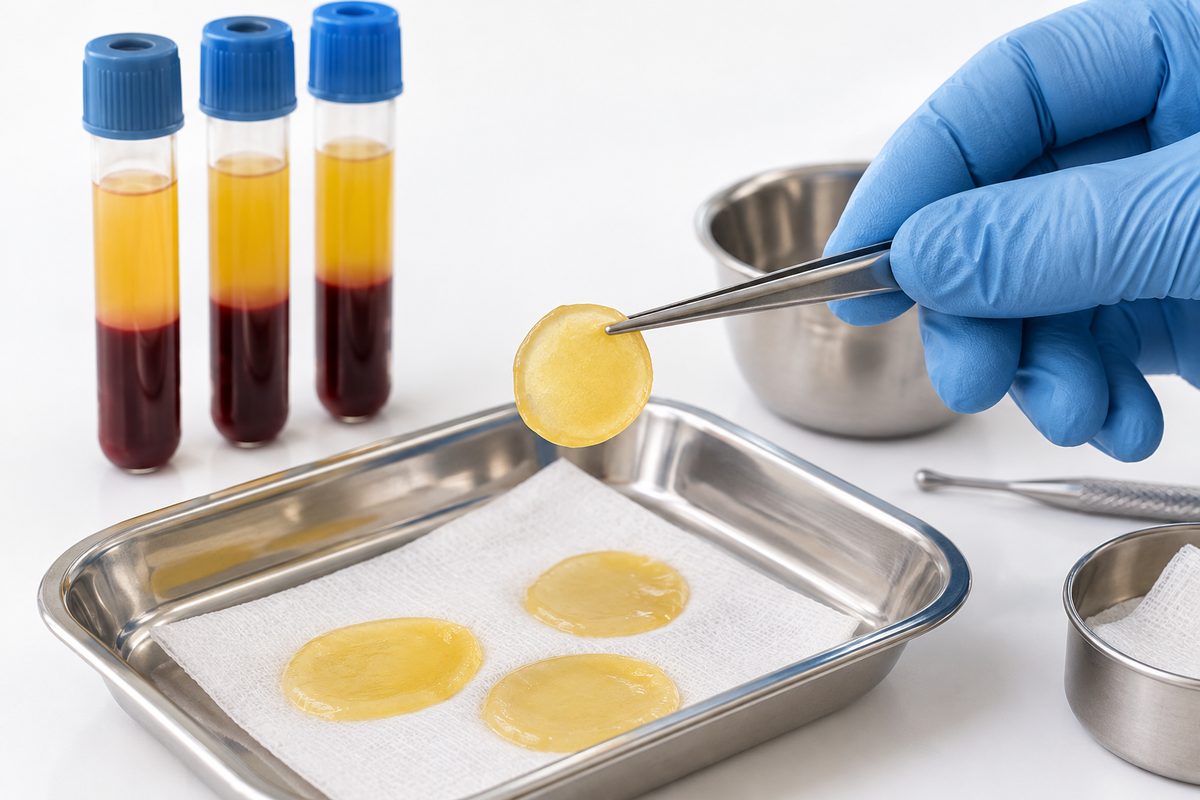
After oral surgery, your body does the healing. Platelet-rich fibrin (PRF) gives it a head start, using a concentrate made from a small sample of your own blood, with nothing added. Dr. Fattah uses PRF across our biologic surgical protocol, from extractions and wisdom teeth to ceramic implants and cavitation surgery.
Call (480) 607-6937 to ask whether PRF is part of your treatment plan.
Book a ConsultationKey takeaways
- PRF is made from your own blood, spun in our office, with no additives.
- It concentrates platelets, white blood cells, and growth factors in a natural fibrin mesh.
- We use it in extractions, implants, bone grafts, cavitation surgery, and jaw joint injections.
- Research supports benefits for soft-tissue healing and comfort; results vary.
What Is PRF?
Platelet-rich fibrin (PRF) is a healing material made from a small sample of your own blood. The sample is spun in a centrifuge, which separates out a layer rich in platelets, white blood cells, and a natural fibrin mesh. That layer forms a soft, gel-like clot that slowly releases the growth factors your body already uses to heal.
Unlike its predecessor, PRP (platelet-rich plasma), PRF uses no anticoagulants or additives. Nothing is added to your blood, and nothing foreign goes back into your body.
Because it comes from you, PRF fits our biological approach: supporting your body's own healing rather than adding more materials.
How We Use PRF
Extractions & wisdom teeth
PRF fills the cleaned socket, often mixed with bone graft, to support healing of the gum and bone. See wisdom teeth.
Implants & bone grafts
PRF is mixed into bone grafts and placed as a membrane over them when we prepare for and place ceramic implants.
Cavitation surgery
After a jawbone cavitation is cleaned and disinfected, PRF and graft fill the site, with a PRF membrane on top.
Implant removal
When a titanium implant is replaced with ceramic, PRF supports the grafted site while bone heals.
Jaw joint injections
PRF is one of the injections we offer for jaw joint pain, usually alongside a splint and physical therapy. Research here is still growing.
With ozone & laser
PRF is part of our biologic surgical protocol, together with ozone and laser disinfection.
Making PRF, Step by Step
- A small blood draw. We take a few tubes of blood from your arm at the start of your procedure, much like a routine lab test.
- A short spin. The tubes go into a centrifuge in our office for several minutes.
- Preparing PRF. The PRF layer is separated from the red cells and shaped into a plug, pressed into a thin membrane, or mixed with bone graft.
- Placement. It's placed in the surgical site in the same visit, while it's fresh.
The forms of PRF
- Plugs fill an extraction socket.
- Membranes cover a graft or surgical site.
- Graft mixture: PRF combined with bone graft particles holds them together and is easier to shape.
The Four Phases of Healing
Every surgical site heals in overlapping stages. PRF is placed at the very start, so its growth factors are there as the early stages begin.
| Phase | When | What happens |
|---|---|---|
| 1. Hemostasis | First few hours | Platelets gather and a fibrin clot forms to seal the site. |
| 2. Inflammation | About 1 to 6 days | White blood cells arrive to clear bacteria and debris. |
| 3. Proliferation | About 4 to 21 days | New tissue and blood vessels form, and the wound closes over. |
| 4. Remodeling | 3 weeks to 2 years | Collagen matures and the new tissue gradually gains strength. |
PRF is itself a concentrated fibrin clot rich in platelets and white blood cells: the same building blocks the body uses in the first two phases. Timelines are typical ranges and vary from person to person.
What the Research Shows
PRF has been studied in oral surgery for nearly two decades. Systematic reviews report that, in many procedures, PRF can help with soft-tissue healing and comfort after surgery, and may help preserve bone after an extraction. Results vary between studies, procedures, and patients, and PRF isn't a guarantee of faster healing.
| Area | What studies generally report |
|---|---|
| Extraction sockets | Less loss of bone width and height after extraction in several trials, and less pain and swelling in some |
| Wisdom teeth | In some studies, lower rates of dry socket and less early discomfort |
| Gum and soft tissue | Faster soft-tissue closure and healing of the gum over surgical sites |
| Bone grafting | Easier graft handling; evidence for added bone gain is mixed |
Is PRF Safe?
Because PRF comes from your own blood with nothing added, the risk of allergy or rejection is extremely low. The main things you'll notice are the blood draw itself, and occasionally a small bruise on the arm.
Please tell us if you take blood thinners, have a bleeding or platelet disorder, or are being treated for anemia or a blood condition. These don't always rule out PRF, but they change how we plan.
Who it may not suit
PRF may not be appropriate for people with certain blood disorders or very low platelet counts, or when a blood draw isn't possible. Dr. Fattah will review your health history with you before surgery.
What Our Surgical Patients Say
“I needed a deep cleaning and 3 teeth removed. I bravely did the procedure fully awake with numbing. Dr. Fattah was reassuring and gentle. I hardly felt a thing! Needless to say, my fear of the dentist is no more.”
“my mouth is full of challenging problems which cannot be ignored, including extractions, root canals and a major implant.. Yet I always feel the utmost confidence as Dr. Fattah confidently "tackles the teeth" with his calm and efficient skill and kindness”
★ 5.0 on Google from 440+ reviews · Read more patient reviews
PRF FAQ
What is PRF in dentistry?
Platelet-rich fibrin is a healing material made from a small sample of your own blood, spun in a centrifuge to concentrate platelets, white blood cells, and a natural fibrin mesh. It is placed in surgical sites to support healing.
Is anything added to PRF?
No. PRF uses no anticoagulants or additives. It is made only from your own blood.
How is PRF different from PRP?
PRP (platelet-rich plasma) uses an anticoagulant and is a liquid. PRF uses no additives and forms a gel-like fibrin clot that releases growth factors more slowly over time.
Does the blood draw hurt?
It feels like a routine lab blood draw. If you are having sedation, we can usually draw blood when the IV is placed.
When do you use PRF?
We use PRF in extractions and wisdom teeth, bone grafting, ceramic implants, titanium implant removal, cavitation surgery, and as one of our jaw joint injection options.
Does PRF make healing faster?
Research shows PRF can support soft-tissue healing and comfort and may help preserve bone after extractions, but results vary and it is not a guarantee.
Does insurance cover PRF?
Coverage varies by plan. We will explain costs before your procedure.
Related Services
Heal With Your Own Biology
Talk with Dr. Fattah about how PRF, ozone, and laser fit into your extraction, implant, or surgical plan.
This page is for patient education and is not medical advice. Diagnosis and treatment decisions should be made with your dentist and physician based on your individual exam and health history.