Kids' Airway Dentist in Scottsdale, AZ
Pediatric breathing & airway care from age 3, for healthy growth and sleep
 Clinically reviewed by Dr. Kamran Fattah, DMD
At Scottsdale Family Smiles, we look beyond a child's teeth, gums, and jaw. We also evaluate facial development, tongue posture and mobility, breathing, and airway function. Dr. Fattah provides airway evaluations for children from age 3 to find breathing concerns early, while the jaws are still growing and easiest to guide.
Call (480) 607-6937 to learn more about our breathing and airway evaluation and treatment options for your child.
Book an Airway Evaluation- What is a kids' airway dentist?
- Why it matters
- Warning signs
- Causes & risk factors
- Our evaluation
- Slow palatal expansion
- Our appliances
- Our holistic approach
- FAQ
Key takeaways
- A narrow or blocked airway can disturb a child's sleep, growth, behavior, and focus.
- Snoring and mouth breathing are not normal in children and are worth checking.
- We evaluate children from age 3, including tongue tie, jaw development, and 3D airway imaging.
- We use palatal expanders with a slow expansion protocol only, never rapid expansion.
- Every sleep apnea diagnosis is made by a board-certified sleep physician we work with.
What Is a Kids' Airway Dentist?
A kids' airway dentist (sometimes called a pediatric airway dentist) looks at more than cavities. Along with your child's teeth, Dr. Fattah checks how they breathe, how they sleep, where the tongue rests, and how the jaws are growing. These are the things that shape the airway during childhood.
When a child's upper jaw is narrow or the tongue is tied, there can be less room to breathe through the nose, and that often shows up as snoring, mouth breathing, restless sleep, or crowded teeth. Because children's jaws are still growing, gentle appliances can guide that growth. That's why we start airway evaluations at age 3.
Dr. Fattah is a Diplomate of the American Sleep and Breathing Academy and trains other dentists in Vivos therapy. When a child needs care beyond the dental chair, such as from an ENT, a myofunctional therapist, or a sleep physician, we coordinate with them.
The Importance of an Airway Evaluation
An airway that is too narrow, underdeveloped, or blocked can keep a child from breathing well during sleep. That disturbs sleep quality, and poor sleep in children is linked to problems with attention, behavior, mood, and learning. Growth hormone is released mainly during deep sleep, and many of the body's repair processes happen overnight, so ongoing sleep disruption can interfere with healthy growth and development.
The American Academy of Pediatrics recommends that children be asked about snoring at regular checkups, and that children who snore regularly be evaluated further.
Signs Your Child May Have an Airway Problem
The most common signs are mouth breathing, snoring, a narrow jaw or crowded teeth, and a tongue tie. Many show up during the day, not just at night. If you notice any of them, request a child airway evaluation.
At Night
Snoring, mouth breathing, pauses or gasps in breathing, restless sleep, teeth grinding, bedwetting, and unusual sleep positions.
During the Day
Mouth breathing, dark circles under the eyes, tiredness, irritability, trouble focusing, hyperactivity, and poor performance in school.
In the Mouth & Face
Crowded or crooked teeth, a narrow or high palate, tongue tie, trouble swallowing, speech issues, swollen tonsils, chronic sore throats, and allergies.
Why Do Children Develop Airway Problems?
- Anatomy and development: a narrow upper jaw, a recessed lower jaw, or variations in the size of the airway.
- Allergies and infections: persistent allergies or frequent respiratory infections affect the nasal passages and push children toward mouth breathing.
- Enlarged tonsils and adenoids: can block the airway, causing snoring and mouth breathing.
- Tongue tie: a low-resting tongue can limit how the upper jaw develops. See Tongue Tie.
- Environment: pollutants and secondhand smoke contribute to respiratory problems.
Is Your Child at Higher Risk?
Your child may be more likely to have breathing and airway problems if they:
- Have a family history of these conditions
- Were born prematurely, with underdeveloped airways and lungs
- Are overweight and have difficulty breathing
- Have frequent respiratory infections
Our Pediatric Airway Evaluation
- Health and sleep history. We ask about snoring, sleep, behavior, allergies, feeding, and speech.
- Mouth and face exam. We check jaw width and growth, the palate, teeth, tonsils, tongue posture, and tongue tie.
- 3D imaging. A 3D scan lets us see your child's airway from the nasal passages through the space behind the tongue, to find areas that may be narrowed.
- Sleep testing when needed. If we suspect sleep apnea, a sleep study is arranged, and the diagnosis is made by a board-certified sleep physician we work with. See Sleep Studies.
- Your child's plan. We explain what we found and the options. If enlarged tonsils or adenoids are the main issue, we'll recommend seeing an ENT, as removing them is often the first treatment for childhood sleep apnea.
Palatal Expansion: Slow, Never Rapid
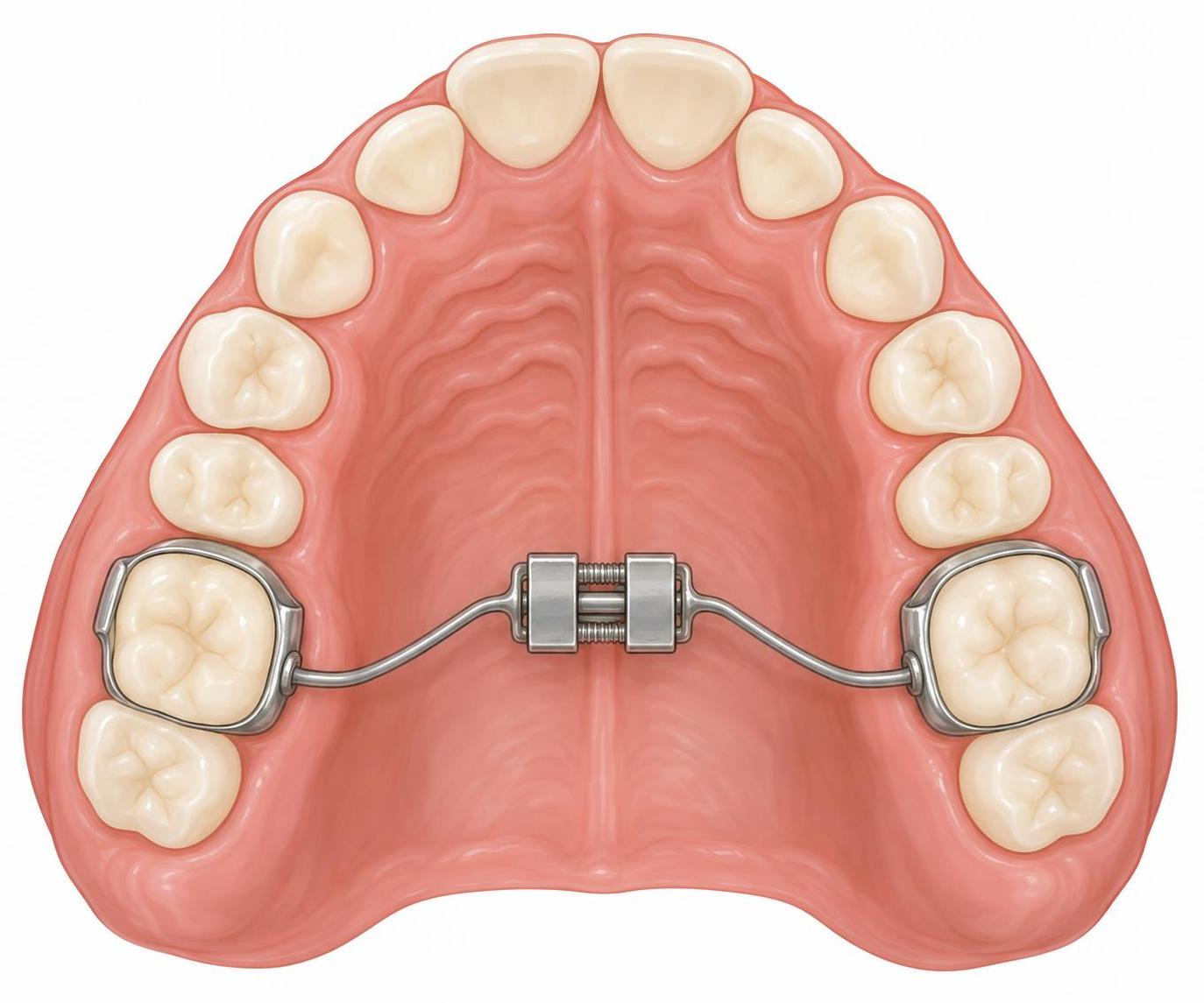
A palatal expander applies gentle, outward pressure to both sides of the upper jaw to widen the midpalatal suture, the seam that runs down the middle of the roof of the mouth. A wider upper jaw makes room for the tongue and teeth, and can widen the floor of the nose.
We use RPE-style expanders, but only with a slow expansion protocol. We do not do rapid expansion. Slow expansion widens the jaw gradually over a longer period, giving the bone and surrounding tissues time to adapt. Dr. Fattah chooses slow expansion because it:
- Promotes less fibrous bone growth in the upper jaw (maxilla)
- Is less painful for children
- Causes less inflammation
- Leads to less relapse of the palate once the expander is removed
| Slow expansion (our protocol) | Rapid expansion | |
|---|---|---|
| Pace | Gradual widening over a longer period | Fast widening, usually over a few weeks |
| Forces | Light and steady | Heavier, quickly separating the suture |
| Comfort | Designed to be gentler, with less pressure and soreness | Pressure and discomfort are common during activation |
| Bone and tissues | Time for bone and soft tissues to adapt as the jaw widens | The gap that opens fills in afterward |
| We offer it | Yes | No |
Research comparing slow and rapid expansion head to head is still limited. A 2022 review of patient-reported outcomes found less pain with slow expansion, though the difference wasn't statistically certain.
The Appliances We Use
Using a system of orthodontic appliances, we help the upper and lower jaws develop and reshape the mouth. As the jaws widen and come forward, there's more room for the tongue and the airway.
| Appliance | Type | What it does |
|---|---|---|
| Palatal expander (RPE-style, slow protocol) | Fixed | Widens the upper jaw at the midpalatal suture, gradually |
| Schwarz upper and lower | Removable | Customized expanders that widen the upper or lower arch |
| 3-way Schwarz | Removable | Widens the arch and lengthens it front to back |
| Rick-A-Nator | Fixed | Treats lower jaw and vertical deficiency that contribute to misaligned teeth and jaws and affect breathing |
| Rick-A-Nator Plus | Fixed | The same benefits, plus expansion of the upper arch |
| Vivos Guide and DNA appliances | Removable | Guide healthy upper and lower jaw development and tooth alignment. The Vivos DNA appliance is FDA-cleared for moderate to severe obstructive sleep apnea and snoring in children 6 to 17. |
Because crowded teeth are often a sign of a jaw that's too small, developing the jaws can also make room for teeth to come in more naturally, which may reduce or avoid the need for braces later. Learn more on our Vivos page.
Our Holistic Approach
"I'm especially passionate about children's facial growth and development. Guiding how a child's jaws and airway develop can change the course of their life, from how they breathe and sleep to how they grow, and that is some of the most meaningful work I do. For every patient, young or old, my goal is the same: compassionate, advanced, biologic dental care that leaves you feeling better than when you came in."
Dr. Kamran Fattah, DMD
Early Intervention
Finding airway issues early, while the jaws are growing, can prevent long-term problems. Regular checkups let us monitor your child's airway as they grow.
Team Care
We work with your child's other providers, such as sleep physicians, ENTs, and therapists, so care is coordinated.
Tongue & Breathing Habits
Myofunctional exercises build nasal breathing, proper tongue posture, and healthy swallowing, and support appliance therapy.
Diet & Nutrition
Nutrition guidance supports overall health and addresses diet-related factors, like inflammation and allergies, that can affect breathing.
Tongue-Tie Release
When a tight frenulum holds the tongue down, a sutured tongue-tie release may be part of the plan.
Custom Plans
Every plan is built around your child's needs and growth, for the most effective and lasting results.
Benefits, Limitations and Alternatives
Potential benefits
- Guides jaw growth while your child is still growing
- More room for the tongue and teeth
- Slow expansion is designed to be gentle
- Care coordinated with ENTs, sleep physicians and therapists
Limitations and risks
- Results depend on your child's age, growth and consistent wear
- Treatment takes months and regular visits
- Appliances can cause brief soreness, speech changes and extra cleaning
- Some children also need care for tonsils, adenoids or allergies
Alternatives
- Evaluation by an ENT or allergist
- Orthodontic treatment at a later age
- Myofunctional therapy
- Monitoring growth at regular checkups
What Patients & Parents Say
“I have had severe jaw issues for over 20 years and no other dentist ever offered a solution for it. It wasn't until I learned about airway dentistry that I found Dr. Fattah—and thank God I did! He put me on a VIVOS DNA appliance which helped me immediately … From the first night I wore it, my sleep improved drastically and my jaw pain/TMJ decreased.”
“My daughter was having trouble breathing while sleeping and another provider recommended surgical intervention. … The Scottsdale Family Smiles team provided us with the resources and services to assist with my daughter’s breathing without the need for surgery. My daughter is now breathing great at night and our fears have been relieved.”
“I took my son in for a consultation concerning his palette and airway. … This kind of dentistry should be more mainstream because it gets down to root causes. … I appreciate that Dr. Fattah doesn’t advocate pulling healthy teeth to make room to move around the teeth for a more straight smile.”
“I now am taking my kids to get their pallets expanded/airways opened. I love how Dr. Fattah explains everything so I know i can make the best decisions.”
“We went in for a second opinion for braces for my son. He was so knowledgeable and I really appreciated he was honest and didn’t just try to make us to switch to them. He have extra recommendations of how to take care of nose health, and prevent mouth breathing at night.”
“They are helping my child expand their palate and I can already see a hugh difference.”
“The care my daughters received was great, working to correct malocclusion and correctly form her jaw has saved her from many potential future problems including avoiding braces in the future.”
★ 5.0 on Google from 440+ reviews · Read more patient reviews
Pediatric Airway FAQ
What is a kids' airway dentist?
A dentist who, along with your child's teeth, checks how they breathe and sleep, how the tongue rests, and how the jaws are growing, and uses gentle appliances to guide jaw growth when the airway is narrow.
How is an airway evaluation different from a regular checkup?
A regular checkup looks mainly for cavities and gum problems. An airway evaluation adds a sleep and breathing history, a check of jaw width, palate, tonsils, tongue posture, and tongue tie, and 3D imaging of the airway when it's needed.
At what age should my child have an airway evaluation?
We see children from age 3 for airway evaluations. Earlier is better, because the jaws are easiest to guide while they're still growing.
Is it normal for my child to snore?
Occasional light snoring with a cold is common, but regular snoring isn't normal in children. The American Academy of Pediatrics recommends that children who snore regularly be evaluated.
Why is mouth breathing a concern?
Children who breathe through their mouths often have the tongue resting low, which can affect how the upper jaw develops. Mouth breathing is also linked to snoring, poor sleep, and dry mouth.
Do you diagnose sleep apnea in children?
No. When we suspect sleep apnea, we arrange a sleep study, and the diagnosis is made by a board-certified sleep physician we work with.
Do you use rapid palatal expanders?
We use RPE-style expanders, but only with a slow expansion protocol. We don't do rapid expansion. Dr. Fattah prefers slow expansion because it is less painful, causes less inflammation, promotes less fibrous bone growth in the upper jaw, and leads to less relapse of the palate after the expander comes out.
Does palatal expansion hurt?
With our slow protocol, most children feel mild pressure rather than pain, especially in the first days after an adjustment.
Will my child still need braces?
Sometimes. Developing the jaws makes more room for teeth, which can reduce or avoid the need for braces later, but some children still benefit from orthodontic treatment to fine-tune alignment.
What if my child's tonsils are enlarged?
If enlarged tonsils or adenoids are the main cause, we'll recommend seeing an ENT. Removing them is often the first treatment for childhood sleep apnea, and jaw development can still help afterward.
Is tongue tie part of the evaluation?
Yes. We check every child for tongue tie, because a tight frenulum can keep the tongue low and affect jaw growth and breathing.
How long does treatment take?
It depends on your child's age, growth, and the appliance used. We'll give you an expected timeline after the evaluation.
Related Services
Is Your Child Struggling to Breathe?
Schedule an airway evaluation with Dr. Fattah. We'll look at the whole picture and build a plan around your child's growth.
This page is for patient education and is not medical advice. Diagnosis and treatment decisions should be made with your dentist and physician based on your individual exam and health history.