Crowns & Bridges in Scottsdale, AZ
Biomimetic, Tooth-Conserving Restorations
 Clinically reviewed by Dr. Kamran Fattah, DMD
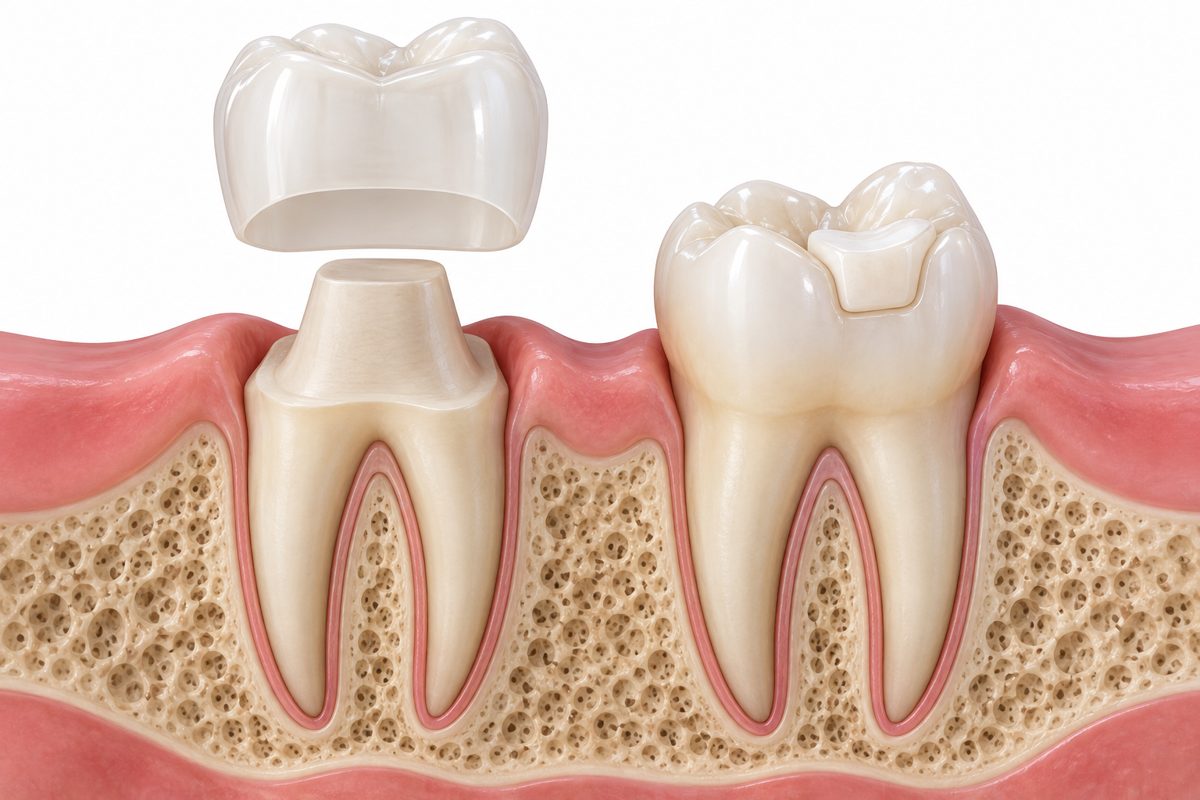
A cracked tooth, a large old filling that's starting to fail, or a tooth that hurts when you bite down can all mean it's time for more than a filling. Our goal is to protect that tooth while keeping as much of it as we can.
Patients in and around Scottsdale trust Scottsdale Family Smiles for dental crowns and bridges. These procedures repair a tooth or group of teeth that have become infected, damaged, or worn, or replace a tooth that's been lost. Our results look natural and help you keep your mouth healthy.
Our first goal is to keep as much of your natural tooth as possible. Wherever we can, Dr. Fattah uses minimally invasive partial crowns, onlays, and inlays instead of full crowns, follows biomimetic principles as he prepares and restores each tooth, and offers material testing to find the material that's most biocompatible for you. Call (480) 607-6937 to learn more.
Book a Consultation- Saving your tooth
- Biomimetic approach
- Material testing
- Replacing metal crowns
- Inlay vs. onlay vs. crown
- Bridges
- Case
- Our process
- How long they last
- FAQ
Key takeaways
- We use partial crowns, onlays, and inlays whenever possible to preserve enamel and remove less tooth.
- Full crowns remove roughly two-thirds to three-quarters of a back tooth's crown; inlays remove far less.
- Dr. Fattah follows biomimetic principles during preparation and restoration: remove only what's damaged, seal, and bond.
- Optional material testing helps us choose the crown material that's most biocompatible for you.
- Ceramic onlays showed about 91% survival at ten years in a 2016 meta-analysis.
Save More of Your Natural Tooth
A traditional full crown covers the entire tooth, which means grinding away healthy enamel on every side to make room for it. Often that isn't necessary. When enough healthy tooth remains, Dr. Fattah restores only the part that's damaged and leaves the rest of your natural enamel in place.
- Inlays fill a cavity or replace an old filling within the cusps of the tooth.
- Onlays replace one or more cusps while keeping the healthy walls of the tooth.
- Partial crowns cover a larger area but still preserve the enamel that's sound.
- Full crowns are reserved for teeth that are too broken down for a more conservative option.
Enamel is the strongest tissue in the body and it doesn't grow back. Keeping it means a stronger tooth, a healthier nerve, and more options if the tooth ever needs treatment again.
Our Biomimetic Approach
Biomimetic dentistry means restoring teeth to work like natural teeth. Dr. Fattah applies biomimetic principles at every step, both when preparing a tooth and when restoring it.
Remove only what's damaged
Decay and weakened tooth are removed carefully, and healthy enamel and dentin are kept wherever possible.
Seal the tooth right away
Freshly exposed dentin is sealed and bonded, which helps protect the nerve and reduce sensitivity.
Bond, don't wedge
Restorations are bonded to the tooth so they support and reinforce what remains, instead of relying on a tight mechanical fit.
Reduce stress on the tooth
Bonding materials are built up in careful layers to limit the shrinkage stress that can lead to cracks and sensitivity.
Materials that behave like tooth
We choose metal-free ceramics and composites that look, flex, and wear more like natural enamel and dentin.
Fit for your body
We consider which materials suit you, including material compatibility testing when it's helpful.
Material Testing: Finding Your Most Biocompatible Material
Every crown, onlay, and filling material is made of different ingredients, and people don't all react to them the same way. For patients who want to know, or who have allergies, sensitivities, or chronic health concerns, we offer dental material compatibility testing through Biocomp Labs before treatment. A simple blood test is compared against more than 17,000 dental materials to show how your body is likely to react to each one, so we can choose the crown or onlay material that's most biocompatible for you.
Testing is optional. Dr. Fattah reviews the results together with your health history and the strength and appearance each tooth needs, and explains which material he recommends and why.
Material testing is part of our biological dentistry approach, along with mercury-safe and BPA-safe, metal-free materials.
Replacing Metal Crowns With Ceramic
Older crowns and bridges are often gold, other metal alloys, or porcelain fused to a metal base. Many patients ask us to replace them with metal-free ceramic, whether the crown is failing, the dark metal edge shows at the gumline, or they want a metal-free mouth.
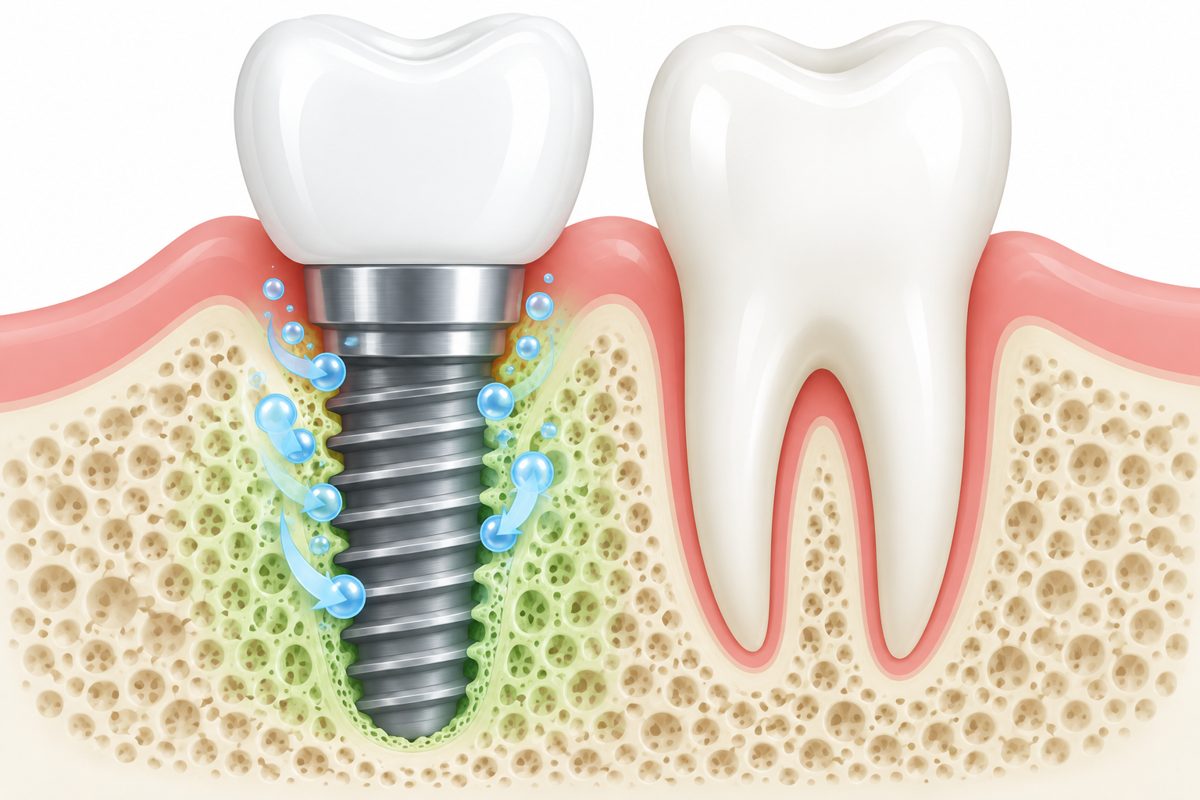
If you have a metal sensitivity, which we can test for, we recommend removing all metals: metal and porcelain-fused-to-metal crowns, metal-based bridges, amalgam fillings, and titanium implants. Replacing one crown while leaving other metals in place doesn't solve the problem.
Whenever possible, we replace an old full crown with a conservative ceramic onlay or partial crown, made in office with CEREC and bonded using the biomimetic approach above. Your material test results guide which ceramic we use.
Metal removal, step by step
- Testing. Metal and material sensitivity testing, plus X-rays to check what's under each restoration.
- A plan for every metal. We map crowns, bridges, fillings, and implants so they're removed in a safe, planned sequence.
- Careful removal. Old metal is sectioned off with high-volume suction and isolation. Amalgam follows our SMART protocol.
- Ceramic restoration. Each tooth is restored with the most conservative ceramic option, often the same day.
- Implants. Titanium implants are replaced with ceramic implants when indicated.
Inlay vs. Onlay vs. Crown vs. Bridge
| Inlay | Onlay or partial crown | Full crown | Bridge | |
|---|---|---|---|---|
| Covers | Inside the cusps | One or more cusps | The whole tooth | Replaces a missing tooth |
| Healthy tooth removed | Least | Moderate | Most | Neighboring teeth are crowned |
| Best for | A medium cavity or an old filling | Large fillings, broken or cracked cusps | Badly broken or very weak teeth | A gap when an implant isn't chosen |
| Enamel preserved | Most | Much of it | Little | Little on the supporting teeth |
| Material | Ceramic or composite | Ceramic or composite | Ceramic | Ceramic |
What Are Dental Bridges?
A bridge replaces a missing tooth for patients who don't want dentures or surgery. It's held in place by crowns on the teeth on either side, so the replacement tooth is secure. The result is a functional tooth that's virtually indistinguishable from your natural teeth.
Because a bridge needs crowns on the neighboring teeth, it means reshaping those teeth too. When they're healthy and unfilled, a dental implant, including a metal-free ceramic implant, can replace the missing tooth without touching them. Dr. Fattah will go over both options with you.
Conservative Onlays Instead of Crowns
Two teeth with large old amalgam fillings. Rather than grinding them down for full crowns, Dr. Fattah removed the old fillings, sealed the teeth, and restored them with tooth-colored bonded onlays that keep the healthy enamel walls.
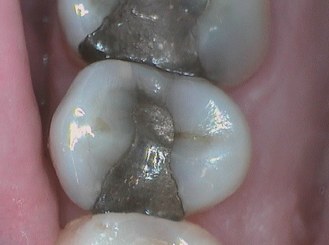
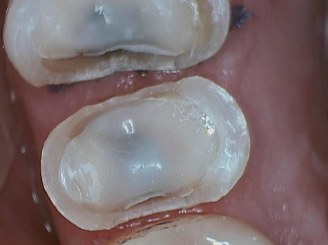
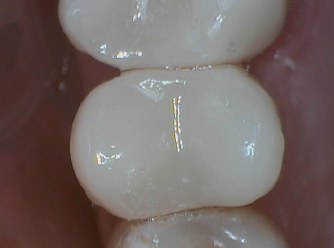
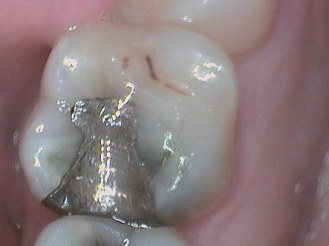
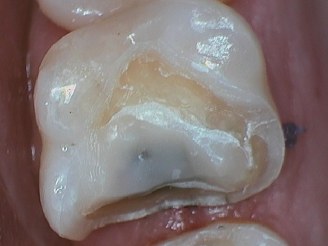
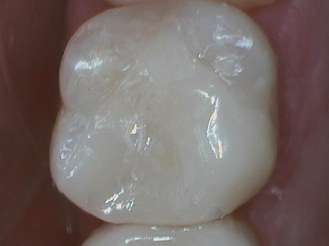
Patient of Dr. Fattah. Photos are unretouched intraoral images.
Our Crown & Onlay Process
- Exam and planning. We look at the tooth, the old fillings or cracks, and your bite, then recommend the most conservative restoration that will last.
- Material choice. We talk through materials, with compatibility testing if you'd like it, so your restoration suits both your tooth and your body.
- Whitening first, if it's cosmetic. Ceramic doesn't whiten. If you'd like whiter teeth, we whiten first so your new restoration matches your brighter shade.
- Biomimetic preparation. Only damaged tooth is removed, the exposed dentin is sealed right away, and the tooth is shaped to keep as much enamel as possible.
- Design and fit. A precise digital scan lets your restoration be custom-made. Many crowns and onlays can be made the same day with CEREC.
- Bonding and aftercare. The restoration is bonded in place and your bite is checked. Some sensitivity for a short time is normal; we recommend going easy on that side for a day.
How Long Do Onlays and Crowns Last?
In a lab study that weighed how much tooth different preparations remove from back teeth, inlay and adhesive preparations removed about 5.5% to 27% of the tooth's crown, while full crowns removed about 67.5% to 75.6%. Onlays and partial crowns fall in between.
Saving that tooth doesn't mean giving up durability. A 2016 systematic review and meta-analysis found that ceramic inlays, onlays, and overlays had estimated survival of about 92% at five years and 91% at ten years. For comparison, a 2015 review found metal-ceramic full crowns survived at about 94.7% over five years.
These are averages across many studies, not guarantees. Restorations last longest with healthy gums, protection from grinding, and regular checkups.
Benefits, Limitations and Alternatives
Potential benefits
- Protects a cracked or weakened tooth
- Onlays keep more natural tooth than full crowns
- Metal-free ceramic matched to your teeth
- A bridge replaces a missing tooth without surgery
Limitations and risks
- Some healthy tooth is removed, more for crowns and bridges than for onlays
- A bridge requires crowning the teeth on either side
- Restorations can chip, wear or need replacing over the years
- Some teeth are sensitive for a short time afterward
Alternatives
- A large bonded filling when enough tooth remains
- A dental implant to replace a missing tooth
- A removable partial denture
What Our Crown Patients Say
“he saved a lot of structure of my tooth! … he only crowned where my tooth was broken at! … He made the crown in the office! He was so focused on minimally invasive treatment! He really cared about my teeth!”
“Just had 2 crowns installed on upper left and right molars by Dr. Kamran Fattah. … I am approaching 70 years old and have had many crowns and dental work done over the years. This was by leaps and bounds the best experience I’ve had. … Bite is perfect!”
“I'm a retired holistic dentist and naturopathic physician, so I have very high standards. … I needed some complex dentistry including a ceramic implant and porcelain crowns. Dr. Fattah managed my case so efficiently that it seemed almost effortless. The final results look and feel both beautiful and natural.”
★ 5.0 on Google from 440+ reviews · Read more patient reviews
Crowns, Onlays & Bridges FAQ
Do I need a crown or an onlay?
It depends on how much healthy tooth is left. If the outer walls of the tooth are sound, an onlay or partial crown can restore it while keeping that enamel. Full crowns are for teeth that are too broken down for a conservative option.
What is biomimetic dentistry?
It's an approach that restores teeth to work like natural teeth: removing only damaged tooth, sealing the exposed dentin, and bonding restorations so they reinforce the tooth. Dr. Fattah uses these principles when preparing and restoring teeth.
What is dental material testing?
It's an optional blood test through Biocomp Labs, done before treatment, that checks your reactivity to more than 17,000 dental materials. Dr. Fattah uses the results, along with your health history, to choose the most biocompatible material for you.
Are your crowns and onlays metal-free?
We favor metal-free ceramics and composites, which look natural and behave more like tooth. Your final material is chosen for your tooth's needs and, if you've been tested, your results.
Can I get a crown in one day?
Often, yes. With CEREC, many crowns and onlays are designed, made, and placed in a single visit.
Should I whiten my teeth first?
If the restoration is on a visible tooth and you'd like a brighter smile, yes. Ceramic doesn't whiten, so we match your crown or onlay to your whitened shade.
When is a bridge better than an implant?
A bridge can make sense when the neighboring teeth already need crowns. When they're healthy, an implant replaces the missing tooth without reshaping them.
Can you replace my old metal or porcelain-fused-to-metal crowns?
Yes. We replace metal and porcelain-fused-to-metal crowns with metal-free ceramic, often as a more conservative onlay or partial crown made the same day. If testing shows a metal sensitivity, we recommend removing all metals from the mouth, not just one crown.
Related Services
Related Reading
Restore Your Tooth, Keep Your Enamel
If you have a broken tooth, a large old filling, or a missing tooth, schedule a consultation. Dr. Fattah will show you the most conservative option that will last.
This page is for patient education and is not medical advice. Diagnosis and treatment decisions should be made with your dentist and physician based on your individual exam and health history.